

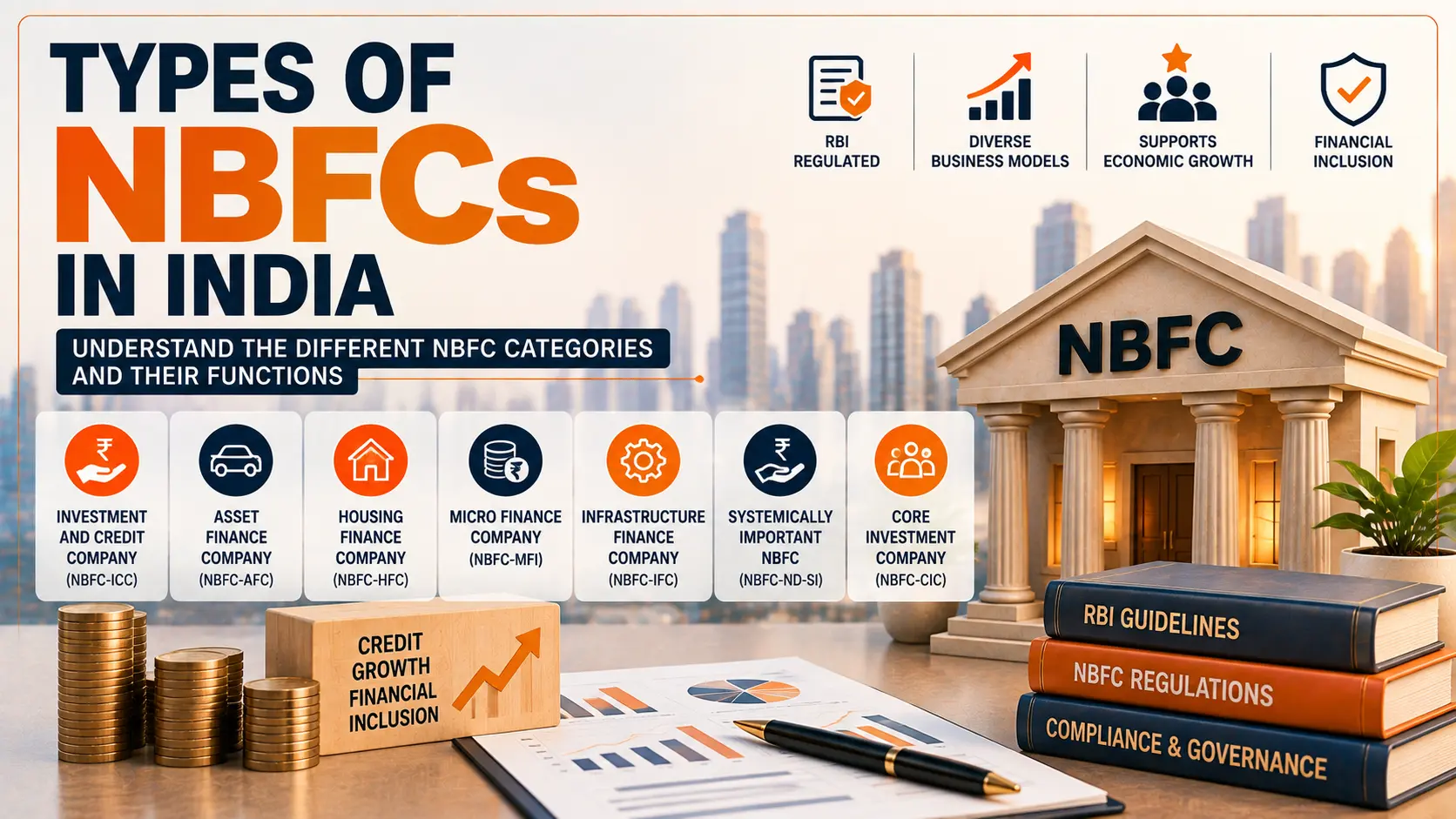
Types of NBFCs in India
Not every Non-Banking Financial Company does the same job. A microfinance lender, a housing finance company and a peer-to-peer platform all hold an RBI licence, yet each follows different rules, capital norms and business limits. Before applying for a licence or choosing an NBFC to deal with, it helps to know which category it belongs to.
The Reserve Bank of India (RBI) classifies NBFCs in three ways: by the kind of liabilities they hold, by their regulatory layer, and by the activity they carry out.
What qualifies as an NBFC?
An NBFC is a company registered under the Companies Act whose principal business is lending, investing in securities, leasing, hire-purchase and similar financial activity. The RBI applies a "50-50 test": financial assets must exceed 50% of total assets, and income from them must exceed 50% of gross income. If you want the basics first, read our guide on What is an NBFC.
1. Classification by liabilities: deposit-taking and non-deposit-taking
Deposit-taking NBFCs (NBFC-D) hold a Certificate of Registration (CoR) that specifically allows them to accept public deposits. They need a minimum investment-grade rating of BBB– and can hold deposits up to 1.5 times their Net Owned Fund (NOF). Deposits must run for 12 to 60 months, and the current maximum interest rate is 12.5%. These deposits are not covered by DICGC deposit insurance.
Non-deposit-taking NBFCs (NBFC-ND) cannot accept public deposits but can raise funds through borrowings, debentures and similar sources.
The RBI has not issued a new deposit-accepting CoR to any NBFC since 1997, so most new NBFCs are non-deposit-taking.
2. Classification by regulatory layer (Scale Based Regulation)
Under Scale Based Regulation, the RBI places NBFCs in four layers, with stricter rules as size and risk increase.
- Base Layer (NBFC-BL): non-deposit-taking NBFCs with assets below ₹1,000 crore, along with NBFC-P2P, NBFC-AA, NOFHCs and NBFCs that neither use public funds nor have customer interface.
- Middle Layer (NBFC-ML): all deposit-taking NBFCs regardless of size, and non-deposit-taking NBFCs with assets of ₹1,000 crore or more. Standalone Primary Dealers, IDF-NBFCs, Housing Finance Companies and Infrastructure Finance Companies sit here because of their activity.
- Upper Layer (NBFC-UL): NBFCs the RBI identifies as needing closer oversight, based on a scoring methodology. The RBI publishes this list periodically.
- Top Layer (NBFC-TL): reserved for Upper Layer NBFCs that show a significant rise in systemic risk. It is meant to remain empty ordinarily.
Recent update:
Through its April 29, 2026 amendment, the RBI exempted "Unregistered Type I NBFCs" from registration under Section 45-IA. These are NBFCs with assets below ₹1,000 crore that use no public funds and have no customer interface. Type I NBFCs with assets of ₹1,000 crore or more must register, and any NBFC that wants public funds or customer interface must register as a Type II NBFC first.
3. Classification by activity
This is the classification most people mean by "types of NBFCs." The RBI's FAQs recognise the following.
- Investment and Credit Company (NBFC-ICC): carries on asset finance, lending for activities other than its own, or acquisition of securities, and does not fall into any other category. It is the most common type.
- Housing Finance Company (HFC): at least 60% of total assets must be in housing finance, and at least 50% of total assets must be housing finance to individuals.
- Infrastructure Finance Company (NBFC-IFC): deploys at least 75% of total assets in infrastructure lending.
- Infrastructure Debt Fund NBFC (IDF-NBFC): a non-deposit-taking NBFC that refinances infrastructure projects after at least one year of satisfactory commercial operations and can lend directly to toll-operate-transfer (TOT) projects.
- Micro Finance Institution (NBFC-MFI): at least 60% of total assets must be in microfinance loans, which are collateral-free loans to households with annual income up to ₹3,00,000. For comparison with other lenders, see NBFC vs Nidhi vs Microfinance.
- NBFC-Factor: primarily engaged in factoring, with factoring assets at least 50% of total assets and factoring income at least 50% of gross income. Factoring businesses must also register under the Factoring Regulation Act, 2011.
- Core Investment Company (CIC): holds at least 90% of net assets in group-company investments, with at least 60% in equity of group companies. It must have assets of ₹100 crore or more and access public funds to require registration.
- Mortgage Guarantee Company (MGC): earns at least 90% of its turnover or gross income from guaranteeing housing loan repayment.
- Standalone Primary Dealer (SPD): authorised to deal in government securities and support the primary and secondary G-Sec market.
- Non-Operative Financial Holding Company (NOFHC): a non-deposit-taking NBFC that holds the shares of a bank and other financial companies in its group.
- NBFC-Account Aggregator (NBFC-AA): collects and presents a customer's financial information, with the customer's consent, for a fee.
- NBFC-Peer to Peer (NBFC-P2P): an online platform that connects lenders and borrowers without lending its own money.
Minimum Net Owned Fund by type
| NBFC type | Minimum NOF |
|---|---|
| ICC, MFI, Factor | ₹10 crore |
| Housing Finance Company | ₹20 crore |
| Mortgage Guarantee Company | ₹100 crore |
| NBFC-IFC and IDF-NBFC | ₹300 crore |
| Standalone Primary Dealer | ₹150 crore (core activities only); ₹250 crore (with non-core) |
| NBFC-AA and NBFC-P2P | ₹2 crore |
New applicants need ₹10 crore NOF from the start. Existing NBFCs have until March 31, 2027 to reach it.
How to choose the right NBFC type
- General lending or investment business: NBFC-ICC.
- Home loans: HFC.
- Low-income, collateral-free loans: NBFC-MFI.
- Project and infrastructure financing: NBFC-IFC.
- Business receivables financing: NBFC-Factor.
- Group holding structure: CIC.
- Digital lending marketplace or data-sharing platform: NBFC-P2P or NBFC-AA.
Your choice affects capital needs, permitted activities and compliance load. Our NBFC registration guide explains the process step by step.
Before you deal with any NBFC
Check that it appears in the RBI's list of registered NBFCs, and if you are placing a deposit, confirm that its CoR specifically authorises deposit acceptance. Entities that make false claims of RBI regulation are liable to penal action.
Conclusion
NBFCs differ by what they hold on the liabilities side, how large and risky they are, and what they do. Knowing these categories helps founders pick the right licence and helps borrowers and depositors judge who they are dealing with. Rules change, so confirm current requirements with the RBI before acting.