

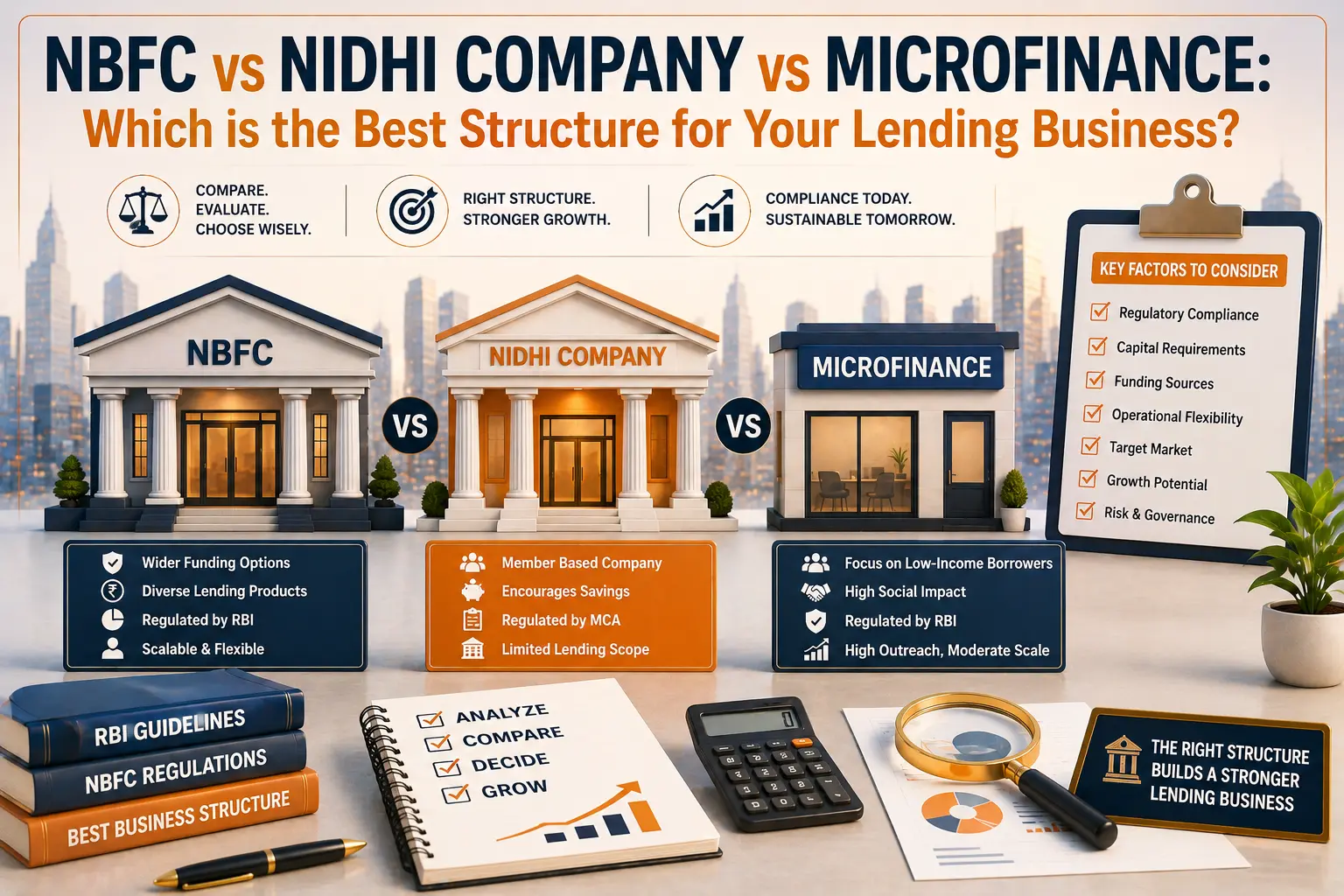
Starting a lending or financial services business in India is highly lucrative, but choosing the wrong corporate structure can lead to severe regulatory penalties or stalling due to capital requirements. Entrepreneurs often find themselves confused by the overlapping terminologies and varying compliance demands of different financial entities. The choice ultimately comes down to your target audience, available seed capital, and willingness to navigate stringent Reserve Bank of India (RBI) or Ministry of Corporate Affairs (MCA) compliance frameworks. Making an informed decision early on prevents roadblocks during scaling and ensures you are legally protected.
NBFC vs Nidhi Company vs Microfinance
The main difference between an NBFC, a Nidhi Company, and a Microfinance institution lies in their regulatory bodies and minimum capital. NBFCs require ₹10 Crore NOF and are regulated by the RBI. Nidhi Companies require only ₹10 Lakhs, are regulated by the MCA, and can only lend to members. Microfinance companies target low-income groups and can be registered as either a Section 8 company (MCA regulated) or an NBFC-MFI (RBI regulated).
Quick Comparison Matrix
| Parameter | NBFC (Investment & Credit) | Nidhi Company | Microfinance (Section 8) | NBFC-MFI |
|---|---|---|---|---|
| Primary Regulator | RBI | MCA (Central Govt) | MCA | RBI |
| Min. Capital | ₹10 Crore NOF | ₹10 Lakhs Paid-up Capital | No minimum (₹1 Lakh recommended) | ₹5 Crore NOF |
| Who can they lend to? | General Public / Businesses | Shareholders / Members only | Poor/Low-income households | Low-income households |
| Can they accept deposits? | Very restricted (Only NBFC-D) | Yes (Only from members) | No | No |
| Area of Operation | Pan-India | District-level (expands later) | State/Pan-India based on approvals | Pan-India |
Deep Dive: Non-Banking Financial Company (NBFC)
When people think of large-scale lending operations, consumer finance apps, and digital credit platforms, they are almost entirely looking at Non-Banking Financial Companies (NBFCs). An NBFC registered as an Investment and Credit Company (ICC) is the heavy hitter of the lending space. It is suitable for large-scale consumer lending, corporate loans, and modern fintech integrations.
The Pros of an NBFC
The primary advantage of an NBFC is its tremendous operational freedom and massive scalability. Once registered with the RBI, an NBFC can lend to virtually anyone individuals, small businesses, or massive corporations across India without geographical restrictions. This structure is the preferred choice for digital lending platforms looking to tie up with technology partners and scale aggressively. Institutional investors, venture capitalists, and private equity firms almost exclusively fund RBI-registered NBFCs due to the rigorous oversight that ensures proper governance.
The Cons and Compliance Burden
However, the barrier to entry is intentionally set very high by the regulator. To register a standard Investment and Credit Company (NBFC-ICC), you must prove a minimum Net Owned Fund (NOF) of ₹10 Crores. The RBI conducts intense due diligence on the directors' profiles, business plans, and the source of funds. Beyond the initial capital, NBFCs are subject to the RBI's stringent Scale-Based Regulation (SBR) framework. Depending on their size and activities, NBFCs are categorized into Base, Middle, Upper, or Top layers, each with escalating compliance demands. Maintaining capital adequacy ratios, adhering strictly to the Fair Practices Code, and filing continuous returns on RBI portals requires a dedicated, ongoing compliance budget.
For more information on setting up, refer to our comprehensive NBFC Registration guide and our latest post on NBFC Digital Lending Guidelines 2026.
Deep Dive: Nidhi Company
If the ₹10 Crore capital requirement of an NBFC is out of reach, a Nidhi Company presents an excellent alternative. Functioning as a mutual benefit society, it is arguably the easiest and most accessible entry point into the formalized lending business in India. The word "Nidhi" translates to treasure or wealth, and these companies operate on the fundamental principle of cultivating a habit of thrift and savings among their members.
The Pros of a Nidhi Company
A Nidhi company is registered as a Public company. The most significant advantage is the exceptionally low capital requirement; you only need a minimum paid-up equity share capital of ₹10 Lakhs. Furthermore, a Nidhi company thrives under the Ministry of Corporate Affairs (MCA) rather than the RBI. Being a type of NBFC, RBI approval is not required. This makes incorporation significantly faster and cheaper. Nidhis are also uniquely positioned because they are legally allowed to accept deposits from their members, a privilege heavily restricted for standard NBFCs.
The Cons and Operational Limitations
The trade-off for this easy setup is severe operational restriction. Nidhi Companies are legally bound to lend and accept deposits only from their registered members. You cannot advertise your lending services to the general public. Additionally, loans must be fully secured; you cannot issue unsecured personal loans or corporate financing. Lending is strictly restricted to loans against gold, silver, property, or fixed deposits.
Furthermore, Nidhi companies face strict geographical limits. Initially, operations are confined to the district level, and they cannot expand branches aggressively in the first three years. Finally, compliance under the Nidhi (Amendment) Rules, 2022 mandates that every Nidhi company must achieve Net Owned Funds of ₹20 Lakhs or more, alongside ensuring they have not less than 200 members.
Deep Dive: Microfinance Institutions (MFI)
Microfinance institutions exist to serve the unbanked and underbanked segments of society. They provide small-ticket loans to low-income households, rural workers, and micro-entrepreneurs. This sector often confuses founders because an MFI can be structured in two completely distinct ways: as a Section 8 Company or as an NBFC-MFI.
Route 1: Section 8 Microfinance Company
A Section 8 company is technically formed as a non-profit organization focused on charity, social welfare, or economic development. Regulated exclusively by the MCA, this route does not require an RBI license. It is a fantastic option for mission-driven founders aiming for rural development lending with smaller seed capital. While there is no statutory minimum capital, starting with at least ₹1 Lakh is recommended to cover operational costs.
Because it does not have RBI oversight, a Section 8 MFI is easier to run for local community lending. However, since it is a non-profit structure, founders cannot extract profits via dividends, and raising large-scale equity funding from traditional venture capital is nearly impossible.
Route 2: NBFC-MFI (Reserve Bank Regulated)
If you intend to run a microfinance business for profit and scale it aggressively, you must register as an NBFC-Microfinance Institution (NBFC-MFI). This structure falls directly under the RBI's jurisdiction. The barrier to entry is substantial: an NBFC-Microfinance requires a ₹5 crore NOF.
While the compliance burden is identical to standard NBFCs, the NBFC-MFI structure offers massive scalability. It allows you to legally generate and distribute profit, expand across India, and most importantly, it grants much easier access to institutional debt funding and bank loans, which is critical for growing a micro-lending portfolio.
Use-Case Scenarios: Which Should You Choose?
Navigating these options requires aligning your business goals with the regulatory realities. Here is a breakdown of when to deploy each structure:
- Choose a Nidhi Company if: You have limited starting capital (under ₹15 Lakhs) and want to test the local lending market. It is the perfect vehicle if you plan to deal exclusively in secured lending like gold loans or loans against property within a tight-knit, localized community where you can easily register borrowers as members.
- Choose a Section 8 Microfinance Company if: You are driven by social impact and want to provide unsecured group loans to low-income women, rural artisans, or farmers. It is ideal if you do not have ₹5 Crore to spare, are not focused on extracting personal dividends, and want to operate without RBI interference.
- Choose an NBFC (ICC or MFI) if: You are building a modern digital lending app, offering corporate finance, or creating a pan-India brand. If you have significant institutional backing, plan to raise venture capital, and have the ₹10 Crore (or ₹5 Crore for MFI) required, the NBFC route provides the ultimate platform for unlimited growth and profitability.
Frequently Asked Questions
Can a Nidhi company be converted to an NBFC?
No, a Nidhi company cannot be directly "converted" into an NBFC. They are governed by different regulatory frameworks (MCA vs. RBI). If you wish to transition, you would need to incorporate a new company, meet the ₹10 Crore NOF requirement, and apply for a fresh NBFC license from the RBI, after which you could potentially acquire or transfer the existing portfolio.
Is RBI approval mandatory for a Microfinance company?
It depends entirely on the corporate structure. If you register the microfinance operation as a Section 8 (non-profit) company under the MCA, RBI approval is not mandatory. However, if you register as a for-profit NBFC-MFI, obtaining an RBI license is strictly mandatory and requires a minimum Net Owned Fund of ₹5 Crore.
Which is better for a gold loan business: Nidhi or NBFC?
For a localized, small-scale startup with limited capital, a Nidhi company is better, as it legally allows lending against gold or silver to members with just ₹10 Lakhs paid-up capital. However, if your goal is to build a pan-India gold loan brand and you have the required ₹10 Crore capital, an NBFC is vastly superior due to its scalability and ability to lend to the general public.
Ready to Structure Your Financial Business?
Choosing the right corporate structure is the most critical decision you will make. A misstep can lead to years of legal headaches, trapped capital, and compliance penalties.