

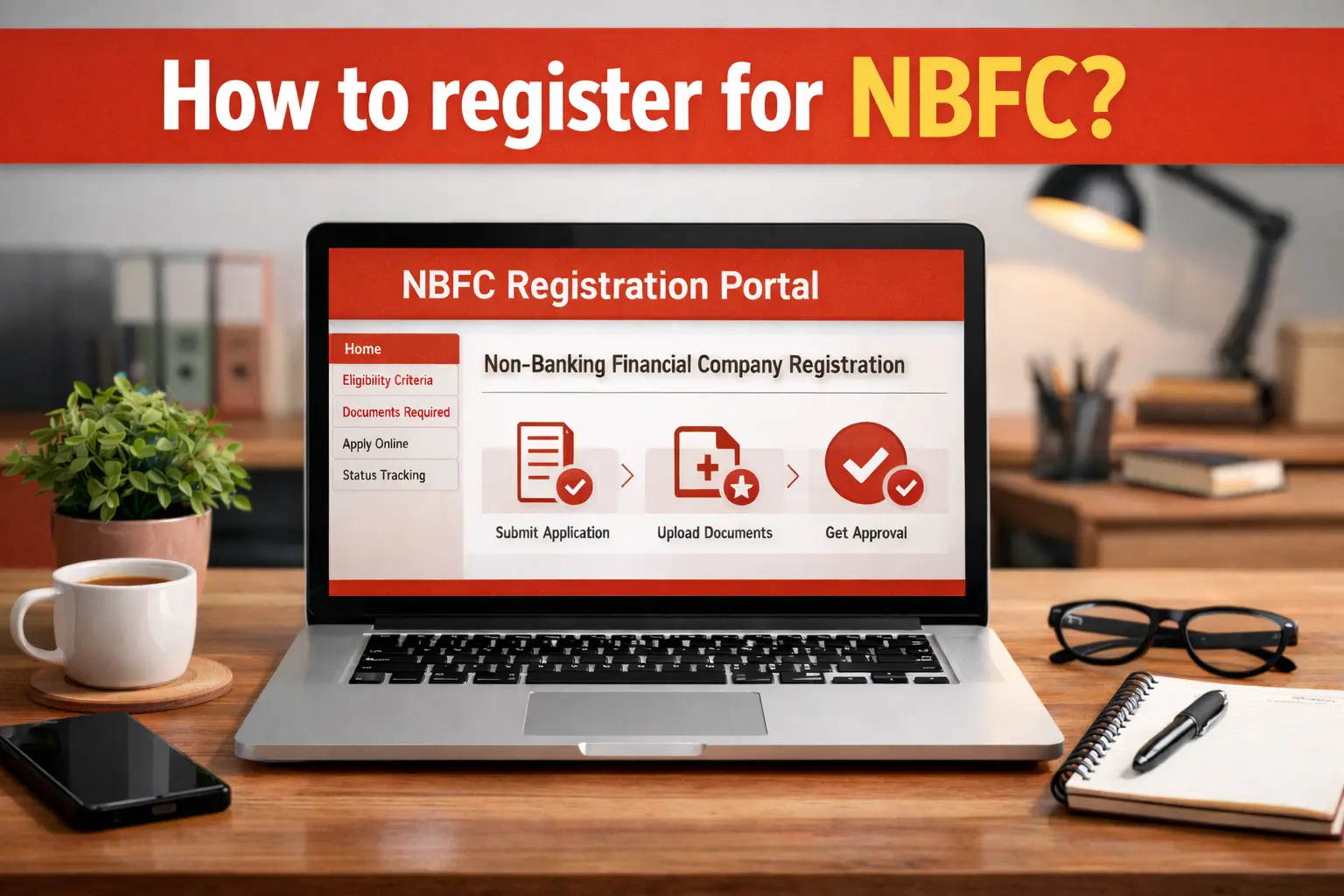
The Non-Banking Financial Company (NBFC) sector is the engine of last-mile credit in India. With the banking sector often saturated, NBFCs provide the flexibility required for niche lending from fintech loans to infrastructure financing.
*Note: While older NBFCs had a glide path to reach ₹10 Cr by 2027, the RBI typically mandates new applicants to meet the full ₹10 Crore requirement upfront to ensure stability.
How to Register an NBFC in India?
The regulatory barrier to entry in the Indian market has risen. With the Scale Based Regulation (SBR) fully operational and the Net Owned Fund (NOF) requirements tightened as of 2026, registering an NBFC requires precision, capital, and a clean track record. This guide details the step-by-step process to obtain your Certificate of Registration (CoR) from the Reserve Bank of India (RBI).Important Regulatory Update (February 2026)Latest News: The “Type I” Exemption Draft
As of February 2026, the RBI has released draft directions proposing to exempt “Type I” NBFCs from registration entirely.If your proposed company meets ALL three criteria below, you may not need to register:
- Asset Size: Less than ₹1,000 Crore.
- No Public Funds: You do not accept deposits or borrow external funds (bank loans, bonds, etc.).
- No Customer Interface: You do not deal directly with retail customers.
Pre-requisites: The “Must-Haves” Before Applying
Before you approach the RBI, your company must meet specific legal and financial baselines.A. Corporate Structure
- You must incorporate a company under the Companies Act, 2013 (or 1956).
- Entity Type: Private Limited or Public Limited Company. (LLPs and Proprietorships are not eligible).
- MoA Clause: The “Main Object” clause in your Memorandum of Association (MoA) must explicitly mention financial activities (lending, investment, etc.).
B. Minimum Net Owned Fund (NOF)
This is the most critical hurdle. Under the new SBR glide path, the capital requirement for new applicants has increased.| NBFC Type | Minimum NOF (New Applicants) |
|---|---|
| NBFC-ICC (Investment & Credit Company) | ₹10 Crore* |
| NBFC-MFI (Micro Finance Institution) | ₹10 Crore |
| NBFC-Factor | ₹10 Crore |
| NBFC-P2P (Peer to Peer) | ₹2 Crore |
C. The “50-50” Test
To be classified as an NBFC, your company must pass the Principal Business Test:- Asset Test: More than 50% of your total assets must be financial assets (loans, investments).
- Income Test: More than 50% of your gross income must come from these financial assets.
Essential Documents Checklist
The RBI’s scrutiny is rigorous. Ensure you have these documents ready before logging into the portal.Corporate Documents
- Certificate of Incorporation (CoI).
- Memorandum (MoA) and Articles of Association (AoA).
- Board Resolution: Specifically approving the formulation of an NBFC and the application for CoR.
Financial Documents
- Banker’s Certificate: A certificate from your bank confirming that the Net Owned Fund (e.g., ₹10 Cr) is deposited in the company’s account and is free from all liens.
- Audited Financials: For the last 3 years (or provisional balance sheets for newly incorporated companies).
- Statutory Auditor Certificate: Certifying the Net Owned Fund balance.
Management & Director Profiles
- CIBIL/Credit Reports: Clean credit reports for all directors are non-negotiable.
- KYC: PAN, Aadhaar, Passport, and latest address proof for all directors/shareholders (>10% stake).
- Experience Certificate: Proof that at least one full-time director has 10+ years of experience in the banking/financial sector.
Operational Documents
- Business Plan: A detailed 3-5 year projection of business operations, target market, and risk management.
- Fair Practices Code: A draft of the fair practices code the company intends to follow.
The Registration Process (Step-by-Step)
The application process has moved from the old COSMOS system to the new PRAVAAH portal.
Step 1: Company Incorporation & Capital Infusion
Register your Pvt Ltd company and deposit the required equity capital (Net Owned Fund) into your corporate bank account. Do not spend this money; it must remain as a Fixed Deposit (FD) during the application process.
Step 2: Online Application on PRAVAAH
- Visit the RBI’s PRAVAAH portal (Platform for Regulatory Application, Validation And Authorisation).
- Create an account and select the application for “Certificate of Registration (CoR) for NBFC.”
- Fill in the COSMOS Form (Form NBFC-I) details digitally.
- Upload all documents from the checklist above (maximum file sizes apply).
- Upon submission, you will receive a Company Application Reference Number (CARN).
Step 3: Physical Submission (If Required)
While the process is digital, many Regional Offices still require a hard copy of the application and the CARN acknowledgement to be submitted to the Department of Non-Banking Supervision (DNBS) of the RBI Regional Office under whose jurisdiction your registered office falls.
Step 4: Scrutiny & Clarifications
The RBI will review your application. This includes:
- Background checks on directors (Police verification/Market intelligence).
- Scrutiny of the source of funds (to prevent money laundering).
- Review of the business model.
Step 5: Grant of Certificate (CoR)
If the RBI is satisfied, they will issue the Certificate of Registration.
Note: You cannot commence lending operations until you physically possess this certificate.
Post-Registration Compliance
Getting the license is just Day 1. You must immediately comply with the following:- FIU-IND Registration: Register with the Financial Intelligence Unit (IND) for PMLA compliance.
- CIC Membership: Obtain membership with all 4 Credit Information Companies (CIBIL, Equifax, Experian, CRIF High Mark).
- C-KYC Registry: Register with CERSAI.
- Statutory Audit: Appoint a Statutory Auditor.
Conclusion
Registering an NBFC in 2026 is a capital-intensive and compliance-heavy process designed to filter out non-serious players. With the entry barrier set at ₹10 Crore for most categories, the focus has shifted from “registering a company” to “building a sustainable financial institution.”Recommendation: Given the complexity of the PRAVAAH portal and the strict “Fit and Proper” criteria for directors, it is highly advisable to engage a Chartered Accountant or a specialized NBFC consultant to navigate the application.