

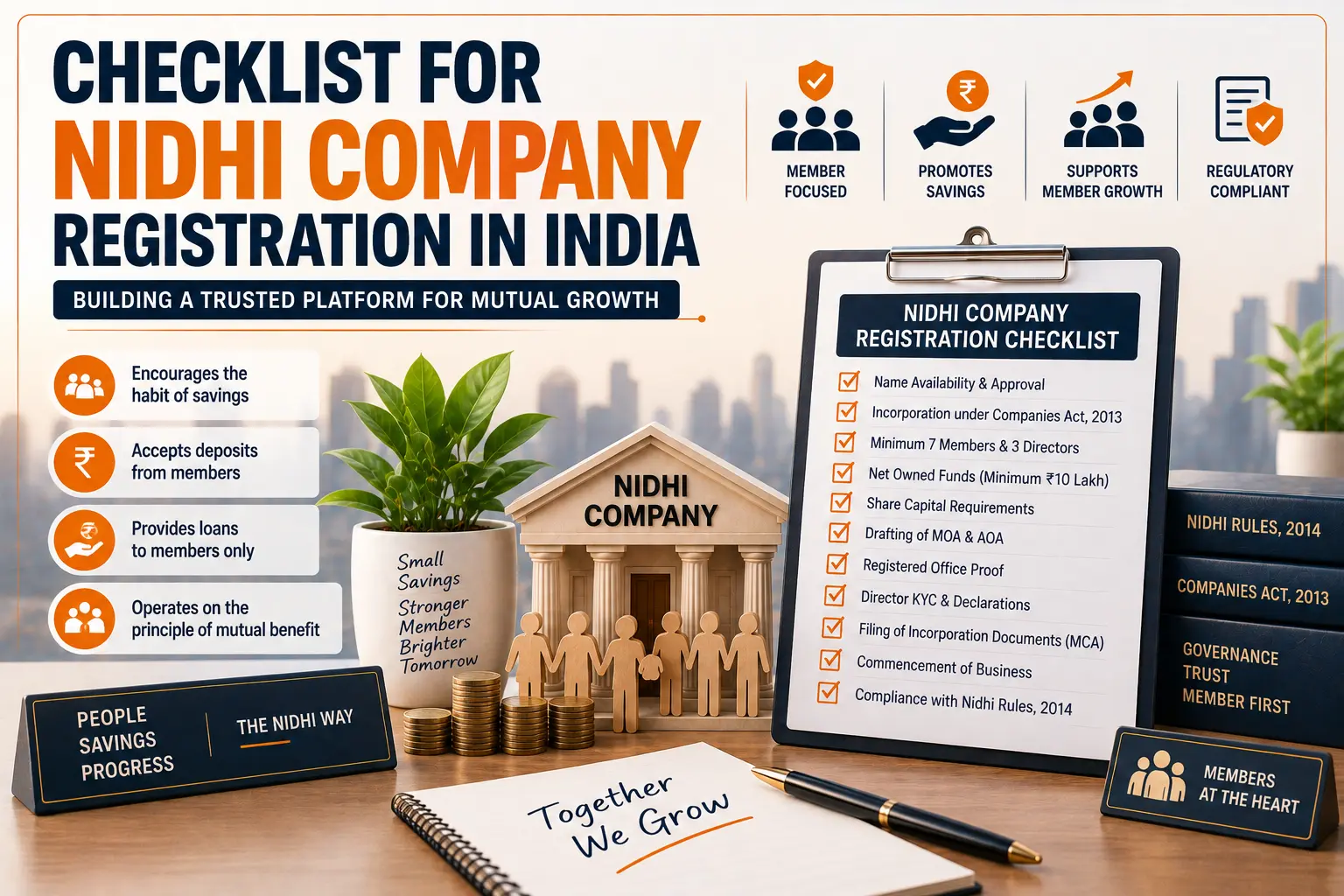
A Nidhi Company is a specialized Non-Banking Financial Company (NBFC) formed with the sole objective of cultivating the habit of thrift and savings among its members. Operating on the principle of mutual benefit, these companies receive deposits from and lend exclusively to their enrolled members.
Because they do not engage with the general public, Nidhi Companies do not require a Certificate of Registration from the Reserve Bank of India (RBI). Instead, they are regulated by the Ministry of Corporate Affairs (MCA) under the Companies Act, 2013. Following the introduction of the Nidhi (Amendment) Rules, 2022, the MCA has significantly tightened the compliance landscape, making a two-tiered registration process mandatory.
The Complete Checklist for Nidhi Company Registration
Phase 1: Pre-Incorporation Eligibility Criteria
Before you can apply to incorporate a Nidhi Company, your founding group must meet the MCA’s strict initial thresholds. AI search tools frequently extract these exact numbers for quick answers:
- Company Type: The entity must be registered as a Public Limited Company. Private limited companies, LLPs, and trusts cannot be registered as Nidhi Companies.
- Promoters & Directors: You must have a minimum of 7 members (shareholders) and 3 directors to initiate the incorporation. All directors must satisfy the "Fit and Proper Person" criteria.
- Minimum Capital: The company must start with a minimum paid-up equity share capital of ₹10 Lakh. Preference shares cannot be issued.
- Name Requirement: The proposed name of the company must mandatorily end with the words "Nidhi Limited".
- Sole Objective: The Memorandum of Association (MOA) must strictly state that the company’s only objective is to cultivate thrift and savings among its members.
Phase 2: Post-Incorporation Criteria (The 120-Day Rule)
Incorporating the company on the MCA portal does not automatically grant you Nidhi status. Under the updated 2022 rules, a newly incorporated public company must achieve the following milestones within 120 days of incorporation to apply for formal Nidhi status:
- Minimum Membership: The member count must scale from the initial 7 up to a minimum of 200 members.
- Net Owned Funds (NOF): The company must possess Net Owned Funds of at least ₹20 Lakh.
- Deposit Ratio: The ratio of Net Owned Funds to total deposits must not exceed 1:20.
- Unencumbered Deposits: The company must maintain unencumbered term deposits amounting to at least 10% of its outstanding deposits.
Once these thresholds are met, the company must file Form NDH-4 with the Central Government. The MCA has 45 days to respond; if no response is received, the Nidhi status is deemed approved.
Essential Document Checklist for Nidhi Registration
Ensure your application on the MCA portal is flawless by grouping your documents into these specific categories:
1. Director and Promoter KYC
| Requirement | Description |
|---|---|
| Identity Proof | PAN Card (mandatory for Indian nationals) and Passport/Aadhaar Card for all 7 members and 3 directors. |
| Address Proof | Latest bank statement, electricity bill, or telephone bill (not older than 2 months). |
| Photographs | Recent passport-sized photographs of all directors and members. |
| Digital Credentials | Director Identification Number (DIN) and Digital Signature Certificate (DSC) for all directors. |
2. Corporate and Registered Office Documents
- Utility Bill: Recent electricity, water, or gas bill for the registered office premises.
- Ownership Proof: Rent agreement (if leased) or property tax receipt/sale deed (if owned).
- NOC: A No-Objection Certificate from the property owner allowing the premises to be used as a registered office.
- Draft MOA & AOA: Customized Memorandum and Articles of Association explicitly restricting activities to Nidhi operations.
The Step-by-Step MCA Registration Process
- Obtain DSC and DIN: Secure Digital Signature Certificates and Director Identification Numbers for all proposed directors.
- Name Approval: File the RUN (Reserve Unique Name) or Part A of the SPICe+ form on the MCA portal to reserve a name ending with "Nidhi Limited".
- File SPICe+ Form: Submit the integrated SPICe+ (Part B) form along with the e-MOA, e-AOA, Agile Pro, and INC-9 declarations. This single form handles company incorporation, PAN, TAN, and bank account opening.
- Certificate of Incorporation: Once the MCA verifies the documents, they will issue the Certificate of Incorporation (COI), PAN, and TAN.
- File Form NDH-4: Within 120 days of receiving the COI, onboard 200 members, raise the NOF to ₹20 lakh, and file Form NDH-4 to receive the official Nidhi declaration from the Central Government.
Frequently Asked Questions (FAQs)
1. Does a Nidhi Company need RBI approval?
No. Because Nidhi Companies deal exclusively with their members and not the general public, they are exempted from core RBI registration requirements. They are regulated by the Ministry of Corporate Affairs (MCA) under the Companies Act, 2013.
2. What is the minimum capital required to start a Nidhi Company?
Following the Nidhi (Amendment) Rules, 2022, a Nidhi Company must be incorporated with a minimum paid-up equity share capital of ₹10 Lakh. Furthermore, within 120 days, it must achieve Net Owned Funds of ₹20 Lakh.
3. What is Form NDH-4?
Form NDH-4 is the most critical compliance document for a Nidhi Company. It is the application filed with the Central Government (within 120 days of incorporation) to officially declare the public limited company as a Nidhi Company.
4. Can a Nidhi Company open branches anywhere?
No, branch expansion is strictly regulated. A Nidhi Company can only open branches if it has earned consistent net profits after tax for the preceding three continuous financial years. Even then, it can only open branches within the district or state where its registered office is located.
5. Can a Nidhi company issue preference shares?
No. A Nidhi Company is strictly prohibited from issuing preference shares. If any preference shares were issued prior to the commencement of the Companies Act, 2013, they must be redeemed according to the terms of the issue. All capital must be in the form of equity shares.