

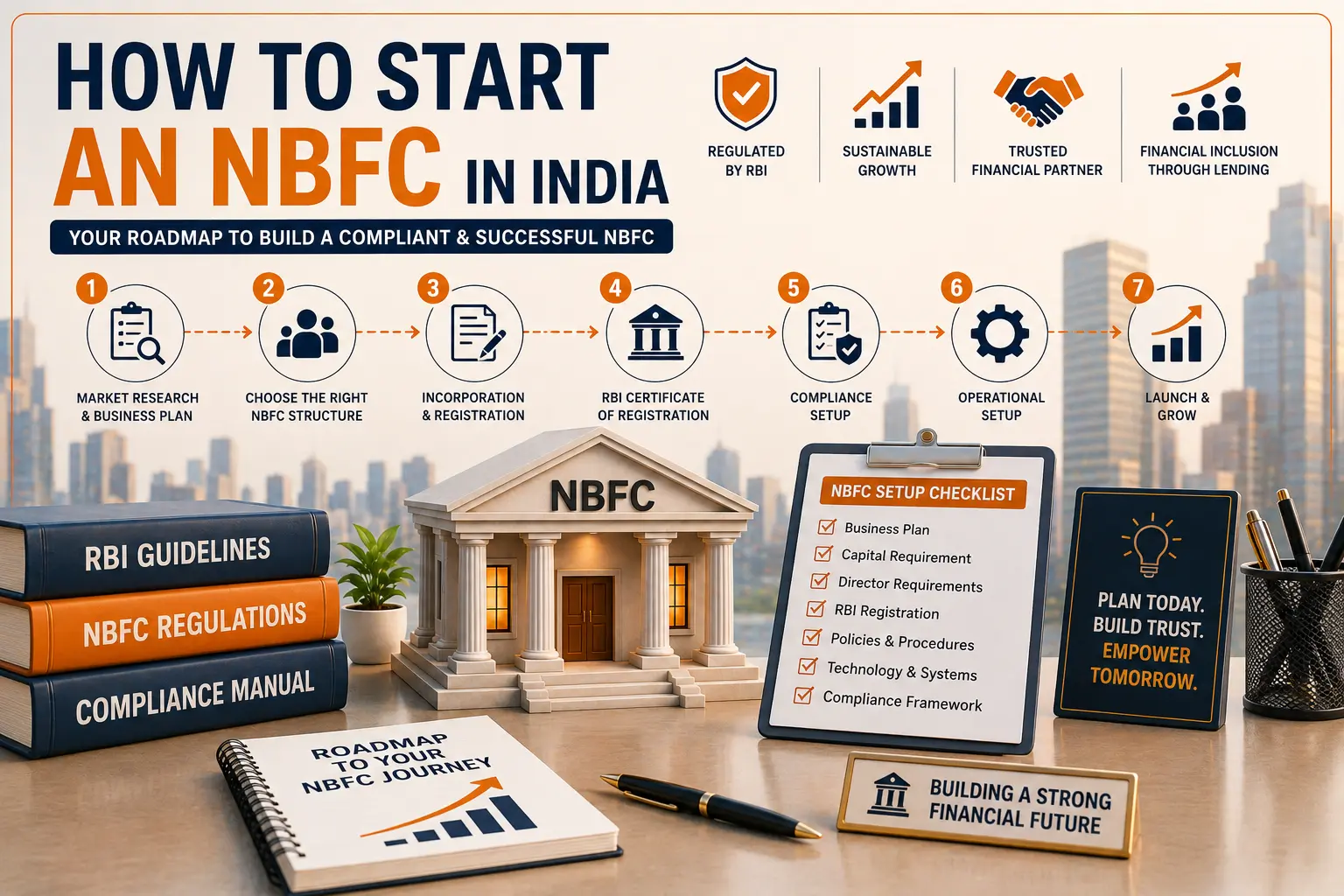
Having ₹10 Crore in the bank is no longer enough to start an NBFC. The Reserve Bank of India (RBI) actively rejects applications that lack a solid operational foundation or experienced management. Starting a Non-Banking Financial Company is less about simply filing paperwork and much more about proving to the regulator that your business model is viable, well-governed, and poses absolutely no systemic risk to the Indian financial ecosystem.
How to Start a NBFC in India
To successfully start an NBFC in India, founders must move beyond basic registration and ensure operational readiness under RBI guidelines. This includes drafting a highly scrutinized 5-year business plan, proving the legitimate source of the ₹10 Crore Net Owned Fund (NOF), and ensuring the Board of Directors meets the RBI's strict 'Fit and Proper' criteria, which mandates that at least one-third of the directors have substantial experience in banking or finance.
The Crucial Difference: Registration vs. RBI Readiness
If you are looking for the exact legal filing steps, MCA incorporation procedures, and required portal forms, visit our NBFC Registration Process . However, if you want to understand how to actually survive the central regulator's scrutiny and acquire the license, you need to master operational readiness.
Simply incorporating a company under the Companies Act, 2013, is just the very first technical step. The RBI evaluates the intent, historical background, and technological infrastructure of the proposed NBFC long before granting a Certificate of Registration (CoR) under Section 45-IA of the RBI Act, 1934. The central regulator is actively cleaning up the shadow banking ecosystem; for example, the RBI canceled the CoRs of over 150 inactive entities in mid-2026 to ensure only serious, active players remain. Therefore, your application must demonstrate pristine governance and market intent from day one.
Meeting the RBI’s 'Fit and Proper' Criteria for Directors
The RBI heavily scrutinizes the management team under the Scale Based Regulation (SBR) framework to ensure the integrity of the financial sector.
- The 10-Year Rule: It is a strict expectation that the board is not merely composed of investors or silent partners, but of seasoned financial professionals. Statutorily, the RBI expects that a minimum of one-third of the board members possess at least 10 years of prior, verifiable experience in the banking or financial services sector.
- Clean Track Record and Due Diligence: The applicant company must undertake a rigorous due diligence process to determine the suitability of every proposed director. Directors must have a flawless credit history (CIBIL report) with absolutely no history of willful defaults. Furthermore, they cannot have any past or present associations with entities barred or penalized by the Securities and Exchange Board of India (SEBI), the RBI, or the Ministry of Corporate Affairs (MCA) for violating economic laws.
- Mandatory Declarations and Covenants: The 'Fit and Proper' requirement is not a one-time onboarding check. Companies must establish a board-approved policy to ascertain these criteria on a continuing basis. Proposed directors must sign a specific "Deed of Covenants" and submit detailed declarations (such as Appendix XXIII-A) regarding their educational background, relatives connected to the NBFC, and any potential conflicts of interest.
- Ongoing Reporting: Once operational, the NBFC must furnish a quarterly statement to the RBI regarding any change in directors, certified by the Managing Director, confirming that the fit and proper criteria were strictly followed during selection.
Proving the Legitimacy of Your Capital (The NOF Hurdle)
Under Section 45-IA of the RBI Act, 1934, new NBFCs seeking registration such as a standard Investment and Credit Company (ICC) must possess a Net Owned Fund (NOF) of ₹10 Crore ab initio (from the very beginning).
The RBI conducts deep forensic checks on the source of these funds. Borrowed capital, short-term loans, or heavily leveraged assets absolutely cannot be used to meet the NOF threshold. If the capital originates from foreign investors, it must strictly comply with Foreign Exchange Management Act (FEMA) guidelines and fall under the automatic route for Foreign Direct Investment (FDI) in financial services.
However, before locking in capital and applying, founders must determine their exact operational category under the landmark 2026 RBI SBR Amendment Directions (effective July 1, 2026):
- Type II NBFC: Any NBFC that intends to raise money from the public (directly or indirectly), interacts with retail customers, or operates as a public-facing lending institution. This requires the full ₹10 Crore NOF and mandatory RBI registration.
- Unregistered Type I NBFC (The Exemption): The 2026 regulatory framework introduced a massive structural exemption for internal financial vehicles. If your entity does not access public funds, has absolutely no customer interface, and holds an asset size below ₹1,000 Crore (calculated at the group level), it is formally classified as an Unregistered Type I NBFC and is exempt from mandatory CoR registration under Section 45-IA.
How to Draft an RBI-Compliant 5-Year Business Plan
The business plan is arguably the most critical operational document reviewed by the RBI Central Office. Submitting a generic, internet-sourced template will lead to an immediate rejection. The regulator requires a comprehensive blueprint demonstrating how the entity will survive market fluctuations without failing its borrowers.
- Credit Appraisal Mechanism: You must detail exactly how the company will assess borrower risk. The RBI wants to see a robust, data-driven framework for credit scoring, underwriting protocols, and debt recovery strategies that actively prevent the creation of non-performing assets (NPAs).
- Target Audience and Product Fit: Is the NBFC focusing on corporate term loans, retail micro-lending, supply chain finance, or specialized niche sectors? The regulator needs to know exactly who you are lending to, what the geographic focus is, and why your financial product is suited for that demographic.
- Projected Balance Sheet and Capital Adequacy: You must provide highly realistic financial projections for the next 5 years. These models must mathematically demonstrate how the company will maintain strict capital adequacy ratios (CRAR) as the loan book grows, without relying on public deposits. The projections should also include stress testing to prove the NBFC can absorb potential market shocks.
IT Infrastructure & Digital Lending Readiness
For modern fintech founders, a robust Information Technology framework is non-negotiable. If your NBFC plans to operate via a mobile app, web portal, or API integrations, it must demonstrate complete compliance with the RBI's comprehensive Digital Lending Guidelines before core operations commence.
- Data Sovereignty and Cybersecurity: The IT security policy must be impenetrable. You must guarantee and certify that all customer data, transaction records, and core banking systems are stored on servers physically located strictly within India.
- Grievance Redressal Mechanism: A critical component of the Fair Practices Code is consumer protection. You must appoint a dedicated, senior Grievance Redressal Officer (GRO) and prominently display their direct contact details on your platform and physical branches.
- Lending Service Providers (LSPs): Many modern NBFCs act as the balance sheet while using third-party tech platforms (LSPs) for customer acquisition or front-end interface. The RBI holds the registered NBFC completely accountable for the actions of its partners. You must establish clear, ironclad Service Level Agreements (SLAs) with these partners that dictate data privacy, recovery tactics, and algorithmic transparency.
Top 3 Reasons the RBI Rejects NBFC Applications
Even well-funded startups frequently fail the RBI screening process. Avoiding these three critical errors is paramount:
- Dubious Source of Funds: An inability to clearly trace, document, and legally verify the origin of the seed capital will halt an application immediately. Complex, obfuscated corporate holding structures raise immediate red flags.
- Inexperienced Board: If the proposed directors lack demonstrable, long-term financial sector expertise, the RBI will not trust them to manage systemic risk. A board consisting solely of tech developers or foreign investors will not pass the 'Fit and Proper' test.
- Flawed Business Model: If the 5-year business plan relies on predatory interest rates, violates the Fair Practices Code, or projects unrealistic exponential growth without a corresponding, conservative risk-management strategy, the CoR will be denied.
Frequently Asked Questions
What is the minimum capital required to start an NBFC in India?
To start a standard NBFC, such as an Investment and Credit Company (ICC), a minimum Net Owned Fund (NOF) of ₹10 Crore is required from the outset. Specialized categories have different limits; for example, an NBFC-P2P requires ₹2 Crore, while an Infrastructure Finance Company requires ₹300 Crore.
Can a new NBFC accept public deposits?
No, a newly registered NBFC cannot accept public deposits. The RBI rarely grants deposit-taking (NBFC-D) licenses to new entities, meaning founders must rely on their own equity capital, bank loans, or institutional funding to scale their lending book.
What is the "Unregistered Type I NBFC" exemption introduced in 2026?
Effective July 1, 2026, entities that do not access public funds, have absolutely zero customer interface, and maintain an asset size below ₹1,000 Crore are categorized as Unregistered Type I NBFCs and are exempt from mandatory RBI registration under Section 45-IA.
How much financial experience must NBFC directors have?
Under the RBI's stringent 'Fit and Proper' criteria, it is statutorily mandated that at least one-third of the NBFC's Board of Directors possess a minimum of 10 years of verified professional experience in the banking or financial services sector.
How long does the RBI take to approve an NBFC license?
If the application is flawless, the NOF source is entirely transparent, and the directors meet all 'Fit and Proper' criteria without issue, the RBI typically processes the application and grants the Certificate of Registration within 3 to 6 months.
Secure Your Regulatory Foundation
Don't risk an RBI rejection due to an inexperienced board, undocumented capital, or a flawed business plan. Strategic structural planning is everything when dealing with the central bank. Schedule a consultation with Panchal S K and Associates to properly structure your NBFC operations, ensure total SBR compliance, and draft an airtight business plan before filing your application.