

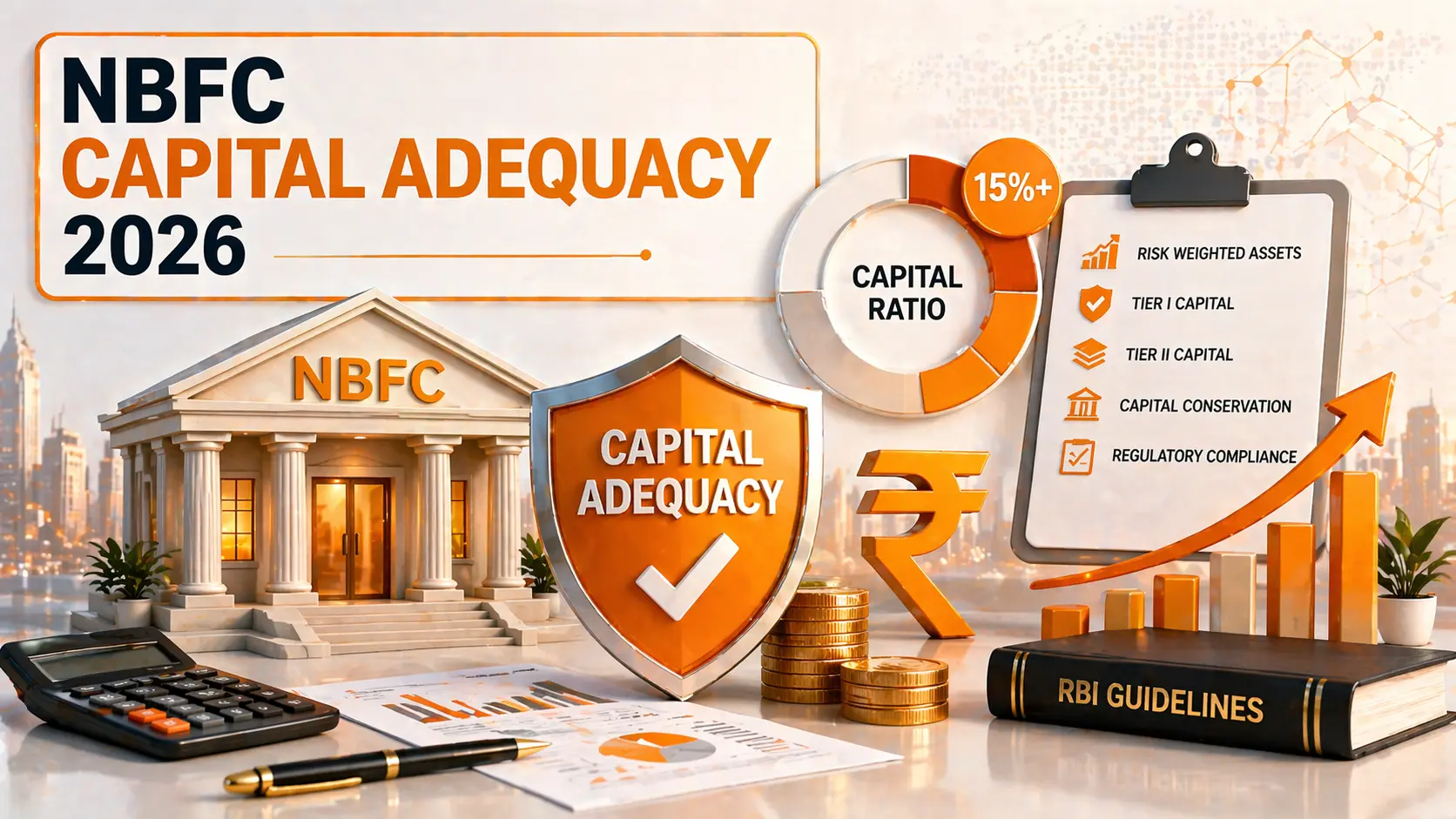
Capital adequacy is the one number the RBI will never let you negotiate. It tells the regulator whether your NBFC has enough financial strength to absorb losses without putting borrowers, lenders, or the broader system at risk. Every registered NBFC must stay above the prescribed floor at all times, not at quarter end, not at year end, but every single day your books are open.
NBFC Capital Adequacy 2026
In 2026, the capital adequacy framework for NBFCs went through two significant changes in just three months. On 13 January 2026, the RBI released draft directions proposing important clarifications on how Owned Fund and Tier 1 capital must be computed. Less than two months later, on 10 March 2026, the RBI issued the Second Amendment to the Prudential Norms on Capital Adequacy Directions, finalising the change that allows quarterly profits to enter the Owned Fund calculation. Together, these two developments change how your CRAR is calculated today.
If your NBFC is still calculating capital adequacy the same way it did in 2024, this guide will tell you exactly what has changed and why it matters for your lending capacity right now.
What Changed in 2026: Two RBI Directions You Must Know
January 13, 2026: RBI issued draft amendment directions clarifying how Owned Fund and Tier 1 capital must be calculated for both CRAR and credit concentration limit purposes. This draft introduced a critical distinction between two different uses of Tier 1 capital. March 10, 2026: RBI finalised the Second Amendment to the Prudential Norms on Capital Adequacy Directions, 2025. This amendment allows NBFCs to include adjusted quarterly profits in the Owned Fund calculation without waiting for year-end audited accounts, directly impacting the CRAR and lending headroom of every profitable NBFC throughout the financial year.
Capital Adequacy Basics: What the RBI Requires in 2026
The core capital adequacy requirement has not changed. Every NBFC must maintain a Capital to Risk-Weighted Assets Ratio of at least 15 percent on an ongoing basis. For every Rs. 100 of risk-weighted assets on your books, you must hold at least Rs. 15 as qualifying regulatory capital. This requirement applies across all layers of the Scale Based Regulation framework.
However, the 15 percent CRAR is a floor, not a ceiling. As your NBFC grows and moves up the regulatory ladder, additional capital requirements layer on top of it. Middle Layer and Upper Layer NBFCs must hold Tier 1 capital of at least 10 percent of risk-weighted assets. Upper Layer NBFCs carry a further requirement to maintain Common Equity Tier 1 capital of at least 9 percent. And NBFCs primarily in gold jewellery lending must keep Tier 1 capital at a minimum of 12 percent, even if they sit in the Base Layer.
| NBFC Category | Minimum CRAR | Minimum Tier 1 | Minimum CET1 |
|---|---|---|---|
| Base Layer NBFC | 15% of RWA | No specific minimum | Not applicable |
| Middle Layer NBFC | 15% of RWA | 10% of RWA | Not applicable |
| Upper Layer NBFC | 15% of RWA | 10% of RWA | 9% of RWA |
| Gold Lending NBFC (all layers) | 15% of RWA | 12% of RWA | As applicable to layer |
| Top Layer NBFC | 15% of RWA + additional charge | 10% of RWA | 9% of RWA |
NOF vs CRAR: Two Capital Requirements, Two Very Different Purposes
Net Owned Fund and CRAR are both capital requirements, but they are not the same thing and they do not serve the same purpose. Mixing them up is one of the most common mistakes in NBFC capital planning.
Net Owned Fund is the minimum entry-level capital an NBFC must hold to register and continue operating. As of 2026, the minimum NOF for a general NBFC is Rs. 10 crore, and for a Housing Finance Company it is Rs. 20 crore. NOF does not change based on your loan book. It stays fixed unless you reduce equity or incur losses that erode reserves. Meeting the Rs. 10 crore NOF threshold does not mean your capital adequacy is sound. It means you are eligible to operate.
CRAR is a living, moving ratio. It changes every time your loan book grows, your asset quality shifts, or you raise fresh capital. An NBFC can sit comfortably above the Rs. 10 crore NOF floor while its CRAR deteriorates steadily because risk-weighted assets are growing faster than capital. Both figures must be tracked separately and monitored continuously throughout the year.
The March 2026 Amendment: Quarterly Profits Now Count in Your Capital
Before 10 March 2026, NBFCs had to wait until their year-end audited accounts were finalised before they could include current-year profits in the Owned Fund calculation. For a profitable NBFC growing its portfolio through the financial year, this meant the CRAR reflected a capital base that was perpetually behind the actual position. The loan book was growing. The profits were real. But the capital ratio was running on last year's numbers.
The Second Amendment fixes this directly. NBFCs can now include adjusted quarterly profits in the Owned Fund computation for capital adequacy purposes, without waiting for the annual audit. The profits must be calculated after tax provisions, dividend provisions, and all applicable regulatory deductions have been accounted for. The inclusion is not automatic. The adjustments must meet the prescribed conditions and must be properly documented.
The practical impact is significant. A profitable NBFC's Tier 1 capital will now reflect its actual financial position at each quarter end rather than its position on the previous 31 March. Higher Tier 1 means a higher CRAR buffer, more room before hitting concentration limits, and reduced supervisory pressure during portfolio growth periods. For NBFCs that have been close to the 15 percent CRAR floor at mid-year, this amendment can make a material difference.
Important: Two Uses of Tier 1 Capital, Two Different Bases of Calculation
The January 2026 draft directions from the RBI introduced a distinction that many NBFC compliance teams have not yet fully processed. Tier 1 capital for calculating CRAR now includes adjusted quarterly profits under the March 2026 amendment. However, Tier 1 capital for calculating credit and investment concentration limits must be based on the latest available audited or limited-review financial statements. These are two separate figures. Using the quarterly-adjusted Tier 1 for both purposes means your concentration limit calculations will be overstated. This is a compliance error that will surface during RBI inspection.
How Risk-Weighted Assets Shape Your Capital Requirement
What Happens When Your CRAR Drops Below 15 Percent
Falling below the minimum CRAR is not a situation the RBI allows NBFCs to manage quietly. If an NBFC's CRAR drops below the prescribed minimum, the regulator has a defined set of tools it can deploy. Supervisory restrictions can include limits on fresh lending, restrictions on dividend payments to shareholders, and a freeze on new branch openings. Persistent non-compliance can trigger placement under the Prompt Corrective Action framework, which imposes increasingly severe operational restrictions the longer the breach continues.
In the most serious cases, sustained capital inadequacy can lead to cancellation of the Certificate of Registration under Section 45-IA of the RBI Act. This is not a theoretical outcome. The RBI has exercised this power in past cases where NBFCs failed to restore their capital position after repeated supervisory directions. Capital adequacy compliance is not a target to aim for. It is a licence condition.
Conclusion
NBFC capital adequacy in 2026 is a more dynamic and more precisely defined obligation than it has ever been. The March 2026 Second Amendment changed how profits enter the capital base, improving the CRAR position of profitable NBFCs throughout the year. The January 2026 draft directions created a clear and important distinction between Tier 1 capital for CRAR and Tier 1 capital for concentration limits, a distinction that every compliance team must build into its calculations immediately.
An NBFC that monitors its CRAR only at year end and has not updated its computation methodology since 2024 is carrying unnecessary regulatory and operational risk. Capital adequacy is a daily obligation, and the cost of falling short even temporarily can range from supervisory intervention to lasting damage to your credit rating and fundraising ability.
Recommended Action for Your NBFC
Review your capital adequacy computation methodology against the Prudential Norms on Capital Adequacy Directions, 2025 and the March 10, 2026 Second Amendment. Confirm that your quarterly profit inclusion meets the prescribed adjustment conditions. Verify that you are maintaining two separate Tier 1 calculations, one for CRAR and one for credit and investment concentration limits. If your CRAR reporting process has not been reviewed since 2024, a compliance assessment by a qualified NBFC specialist before your next RBI inspection is strongly recommended.
Blog Summary
NBFC capital adequacy in 2026 is governed by the Prudential Norms on Capital Adequacy Directions, 2025 along with two major developments in the first quarter of 2026. On January 13, 2026, the RBI issued draft directions clarifying the computation of Owned Fund and Tier 1 capital, introducing a key distinction between Tier 1 for CRAR purposes and Tier 1 for concentration limit purposes, which must be calculated on different bases. On March 10, 2026, the RBI finalised the Second Amendment allowing NBFCs to include adjusted quarterly profits in the Owned Fund calculation without awaiting year-end audits. The minimum CRAR across all NBFC layers remains 15 percent of risk-weighted assets. Middle and Upper Layer NBFCs must additionally hold Tier 1 capital of at least 10 percent of risk-weighted assets, and Upper Layer NBFCs must maintain Common Equity Tier 1 capital of at least 9 percent. Net Owned Fund, set at Rs. 10 crore for general NBFCs, is the entry-level licensing threshold and operates independently of CRAR. Non-compliance with prescribed CRAR norms can lead to supervisory restrictions, Prompt Corrective Action, and in serious cases, cancellation of the Certificate of Registration.
Frequently Asked Questions
1. What exactly changed in NBFC capital adequacy with the March 2026 RBI amendment?
The RBI's Second Amendment to the Prudential Norms on Capital Adequacy Directions, issued on March 10, 2026, allows NBFCs to include adjusted quarterly profits in the Owned Fund calculation for capital adequacy purposes. Before this amendment, only profits confirmed in year-end audited accounts could be added to Owned Fund, which meant an NBFC's CRAR did not reflect current-year profitability until March 31. Under the 2026 amendment, quarterly profits can be included after deducting tax provisions, dividend provisions, and all applicable regulatory adjustments. This means a profitable NBFC's Tier 1 capital and CRAR will be higher at mid-year than under the old system, providing more room for lending and a stronger buffer against falling below the 15 percent floor. However, NBFCs must ensure that the adjusted quarterly profit calculation meets all prescribed conditions and is properly documented, as it is subject to verification during RBI inspections.
2. Why are there two different Tier 1 capital figures and how should an NBFC handle them?
Following the January 2026 draft directions from the RBI, there are now two distinct uses of Tier 1 capital in the NBFC regulatory framework, and each one must be calculated on a different basis. For the purpose of computing CRAR under the Capital Adequacy Directions, Tier 1 capital includes adjusted quarterly profits as permitted by the March 2026 amendment. For the purpose of calculating the maximum credit and investment concentration limits an NBFC can hold against a single borrower or group, Tier 1 capital must be based on the latest available audited financial statements or limited-review statements, not the quarterly adjusted figure. The practical implication is that compliance teams must maintain two separate Tier 1 capital calculations in their working files. Using the quarterly-adjusted figure for both purposes will result in overstated concentration limits, which is a direct compliance violation that RBI inspectors are trained to identify.
3. Can an NBFC continue operating if its CRAR falls below 15 percent temporarily?
An NBFC is required to maintain the minimum CRAR of 15 percent on a continuous and ongoing basis, not on a best-effort basis. If the CRAR drops below 15 percent, even temporarily due to rapid loan book growth or a spike in NPA provisions, the NBFC is in breach of the Prudential Norms on Capital Adequacy Directions, 2025. The RBI does not treat a temporary breach as automatically acceptable. The regulator may impose supervisory restrictions such as halting fresh lending, restricting dividend payments, or preventing new branch openings while the breach persists. If the NBFC fails to restore its CRAR within a reasonable timeframe or shows a pattern of repeated breaches, it can be placed under the Prompt Corrective Action framework, which imposes progressively stricter business restrictions. Persistent and unresolved capital inadequacy can ultimately result in cancellation of the Certificate of Registration under Section 45-IA of the RBI Act, ending the NBFC's right to operate.