

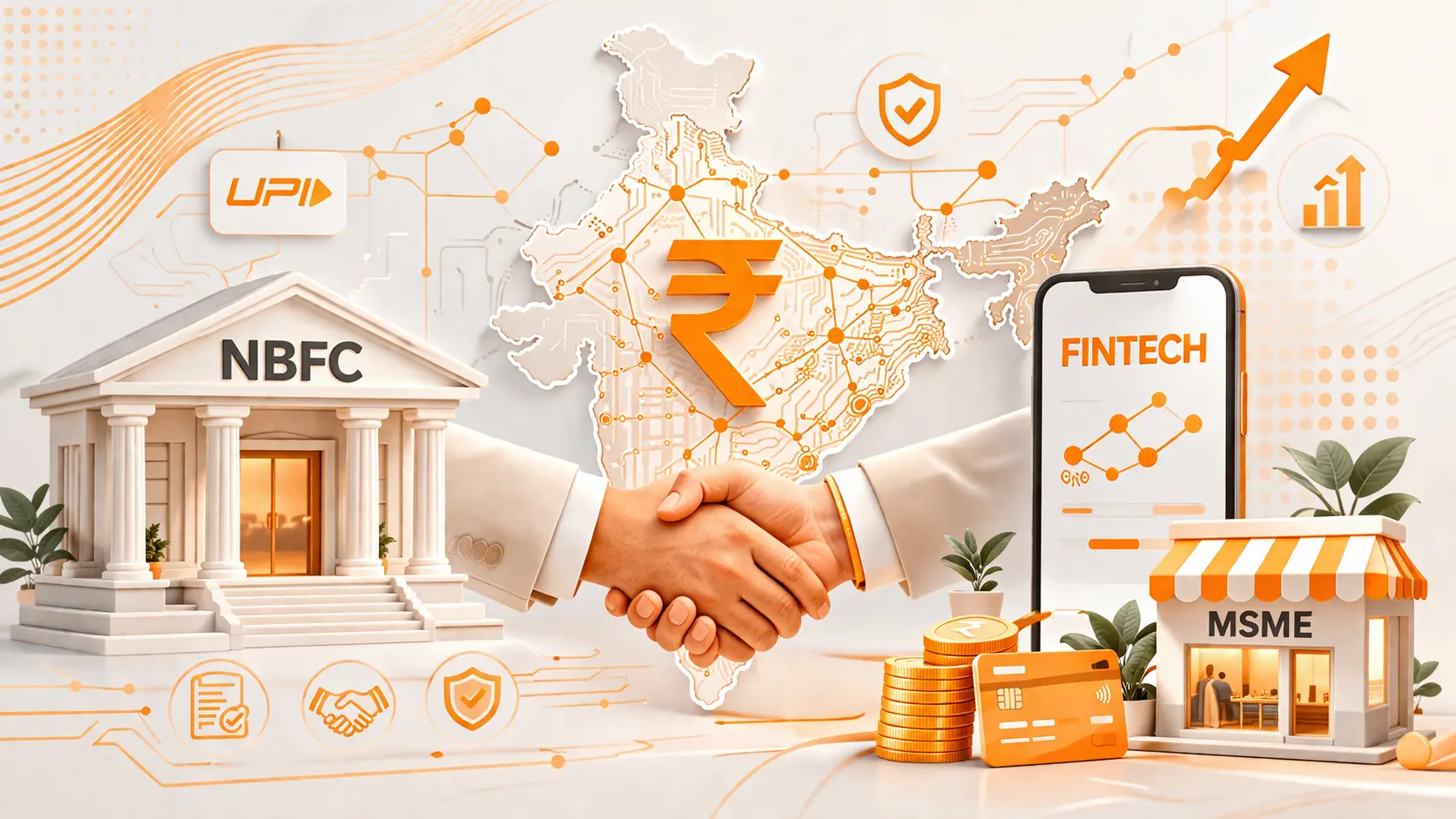
NBFC–Fintech Collaboration
India’s financial ecosystem is undergoing a structural transformation where Non-Banking Financial Companies (NBFCs) and Fintech platforms are building a new architecture of digital lending and financial inclusion.
While NBFCs bring regulatory authorization, lending capital, and risk management expertise, fintech companies contribute technology infrastructure, AI-driven underwriting, digital onboarding, and scalable customer acquisition.
The timing of this collaboration is significant. India today processes 14+ billion UPI transactions every month, making it the largest real-time payment ecosystem in the world. The country hosts 110,000+ startups and a rapidly expanding digital finance market. According to industry estimates, India’s digital lending market is projected to cross $350–400 billion by 2030, growing at over 20% CAGR.
Yet, despite this progress, a critical gap remains. India has over 63 million MSMEs, contributing nearly 30% of GDP and 45% of exports, but the credit gap for MSMEs alone is estimated at $300 billion. Additionally, millions of gig workers, small retailers, and new-age entrepreneurs remain outside formal banking systems due to traditional underwriting limitations.
This is where NBFC–Fintech collaboration becomes transformative - enabling instant digital lending, alternative credit scoring, embedded finance models, and last-mile financial access.
Current Affairs: Regulatory Evolution Shaping the Sector
India’s regulators have taken significant steps to ensure that digital lending remains transparent, accountable, and consumer-centric.
The Reserve Bank of India Digital Lending Guidelines (2022) clearly define the framework for partnerships between NBFCs and fintech companies.
Under these guidelines:
- Fintech companies function as Loan Service Providers (LSPs)
- The regulated entity (NBFC) remains responsible for loan origination, disbursement, and compliance
- Loan disbursement must occur directly into the borrower’s bank account
- Borrowers must receive a Key Fact Statement (KFS) detailing interest rates, charges, and repayment terms
- Explicit customer consent for data access is mandatory
Additionally, the RBI has strengthened oversight through Scale Based Regulation (SBR), categorizing NBFCs into Base Layer, Middle Layer, Upper Layer, and Top Layer depending on systemic importance and risk exposure.
Global Examples of NBFC–Fintech Collaboration
Several fintech platforms globally and in India demonstrate how technology and regulated finance can work together to expand credit access.
Global Case Studies
- Stripe Capital (USA) – Provides working capital loans to small businesses using transaction data from merchants.
- Klarna (Europe) – Built a global Buy Now Pay Later (BNPL) ecosystem integrated with thousands of online retailers.
- Affirm (USA) – Uses AI-driven credit scoring to provide consumer financing embedded into e-commerce platforms.
- Ant Group / Alipay (China) – One of the world’s largest digital finance ecosystems using big data analytics to expand credit distribution.
Indian Ecosystem Examples
- Paytm - Collaborating with NBFC partners for merchant lending
- Razorpay - Providing embedded finance for MSMEs
- Lendingkart - Enabling collateral-free loans to small businesses using digital credit assessment
- ZestMoney - Offering consumer financing through fintech lending infrastructure
These partnerships allow credit decisions to be made within minutes instead of weeks, drastically improving financial inclusion.
Key Regulatory Bodies in NBFC–Fintech Partnerships
Any NBFC–Fintech structure must interact with multiple regulatory and compliance institutions.
Core Regulators
- Reserve Bank of India (RBI) – NBFC licensing, digital lending regulations
- Financial Intelligence Unit – India (FIU-IND) – Anti-money laundering compliance
- Ministry of Corporate Affairs (MCA) – Corporate governance and filings
- Central Registry of Securitisation Asset Reconstruction and Security Interest of India (CERSAI) – Fraud prevention and security interest registration
Credit Information Agencies
- TransUnion CIBIL
- Experian
- CRIF High Mark
- Equifax
Things to Consider Before an NBFC–Fintech Tie-Up
A successful partnership requires careful evaluation from both sides.
From NBFC Perspective
- Technology capability and fintech platform stability
- Cybersecurity and data protection framework
- Customer acquisition strategy and distribution channels
- Risk-sharing model and underwriting standards
- Compliance with RBI digital lending guidelines
- Transparent revenue-sharing structure
From Fintech Perspective
- Valid NBFC license and regulatory standing
- Adequate capital strength and liquidity support
- Strong governance and compliance culture
- Loan portfolio monitoring and recovery mechanisms
- Integration capability with digital APIs and lending platforms
Compliance Checklist Before Launching the Model
A professionally structured NBFC–Fintech collaboration must ensure the following:
- RBI Certificate of Registration (CoR) for NBFC
- Minimum Net Owned Fund requirement (₹10 crore for most NBFC categories)
- Board-approved digital lending policy
- Loan Service Provider (LSP) Agreement
- Customer grievance redressal system
- Fair Practices Code implementation
- Integration with credit bureaus
- Cybersecurity and data privacy framework
- Compliance with KYC, AML, and PMLA norms
Documentation Required for NBFC–Fintech Partnership
A well-structured tie-up requires clear documentation, including:
- Loan Origination and Servicing Agreement
- Technology Integration Agreement
- Revenue Sharing and Risk Participation Framework
- Data Protection and Confidentiality Agreement
- Customer Consent and Data Usage Policy
- Compliance and Regulatory Reporting Protocols
- Business Continuity and Disaster Recovery Framework
The Strategic Importance of NBFC–Fintech Collaboration for India
India’s digital public infrastructure - including UPI, Aadhaar, Account Aggregator framework, and digital KYC - has created a powerful foundation for fintech innovation.
These developments allow NBFC–Fintech partnerships to deliver:
- Instant digital loan approvals
- Alternative credit scoring using data analytics
- Embedded finance in e-commerce platforms
- Financial inclusion for underserved populations
For India’s MSME sector, which employs over 110 million people, improved access to digital credit can significantly accelerate entrepreneurship and economic growth.
The Road Ahead
The future of finance will not be defined by standalone institutions but by collaborative ecosystems combining regulatory credibility and technological agility.
- NBFCs bring trust, governance, and capital discipline
- Fintech companies bring innovation, speed, and scalability
Together, they are redefining how credit flows through the economy.
How Panchal S K & Associates Can Assist?
At Panchal S K & Associates, we being one of the leading CA firms of India and present globally with our services, actively support NBFCs, fintech platforms, and financial institutions in building compliant and scalable digital lending partnerships.
Our expertise includes:
- NBFC registration and RBI licensing
- Structuring NBFC–Fintech collaboration models
- Regulatory compliance under RBI digital lending guidelines
- Drafting LSP agreements and fintech partnership contracts
- Risk management frameworks and governance advisory
- KYC, AML, FIU-IND and regulatory reporting compliance
- Strategic advisory for fintech expansion and digital finance models
For institutions exploring NBFC–Fintech collaboration, the right regulatory structure and governance framework are critical to long-term success.