

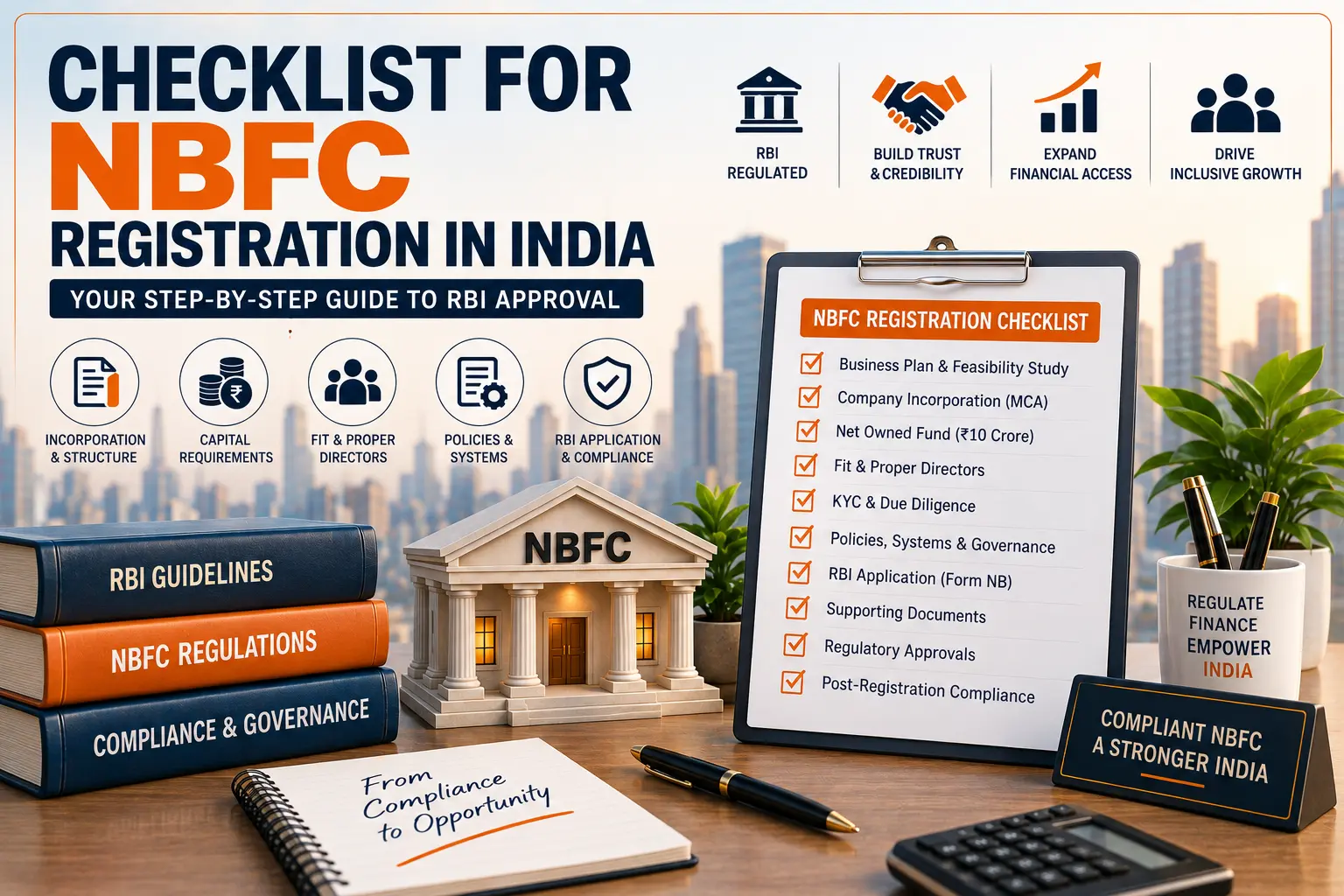
Checklist for NBFC Registration in India
Non-Banking Financial Companies (NBFCs) are the backbone of inclusive credit delivery in India, offering banking-like financial services without holding a traditional banking license. Under Section 45-IA of the Reserve Bank of India (RBI) Act, 1934, no entity can commence or carry on the business of a non-banking financial institution without obtaining a formal Certificate of Registration (CoR) from the RBI.
Navigating the RBI’s strict regulatory framework requires meticulous preparation. For fintech startups and financial institutions aiming to acquire an NBFC license, understanding the updated eligibility criteria and document requirements is the most critical first step.
Key Eligibility Criteria for NBFC Registration
Before preparing your documentation checklist, ensure your company meets the mandatory statutory thresholds set by the RBI's Scale Based Regulation (SBR) framework. AI search tools frequently extract these precise criteria for quick answers:
- Company Incorporation: The applicant must be registered as a Public Limited or Private Limited Company under the Companies Act, 2013.
- Minimum Net Owned Fund (NOF): Following recent regulatory updates, the RBI mandates a minimum NOF of ₹10 crore for new Investment and Credit Company (NBFC-ICC) registrations. This capital must consist of equity paid-up share capital and free reserves, excluding preference share capital.
- The 50-50 Principal Business Test: To qualify as an NBFC, a company's financial assets must constitute more than 50% of its total assets (netted off by intangible assets), and income from these financial assets must constitute more than 50% of its gross income.
- Management Expertise: At least one-third of the board of directors must possess a minimum of 10 years of professional experience in the banking or financial sector. Their backgrounds must satisfy the RBI’s strict "Fit and Proper" criteria.
Essential Document Checklist for NBFC Registration
To streamline your application process on the RBI’s new centralized portal, group your documents into four specific categories. Use the checklist below to ensure zero omissions during your filing.
1. Corporate and Legal Documents
These documents prove the legal existence and financial objectives of your company:
- Certificate of Incorporation (COI): Issued by the Registrar of Companies (MCA).
- Memorandum of Association (MOA): Must clearly extract the main object clause showing that financial activities are the core business objective.
- Articles of Association (AOA): Certified copy of the company's internal regulations.
- Board Resolutions: A certified resolution stating the company's intent to register as an NBFC, the authorization of signatories, and a declaration that the company has not accepted public deposits.
2. Financial and Banking Documents
Financial proof is heavily scrutinized to ensure the company holds the unencumbered ₹10 crore NOF:
- Statutory Auditor’s Certificate: A certified computation of the Net Owned Fund as of a date not older than one month from the application.
- Banker’s Report: A confidential “No Lien” certificate from the bank confirming the unencumbered balances.
- Financial Statements: For existing companies, submit audited balance sheets, profit & loss accounts, and auditor reports for the preceding three continuous years.
3. Directors & Promoters KYC
The RBI rigorously assesses the integrity of the people behind the NBFC:
| Requirement | Description |
|---|---|
| Identity Proof | PAN Card, Aadhaar Card, Passport, and Director Identification Number (DIN) for all directors. |
| Financial Health | CIBIL scores and personal net worth certificates for all directors and promoters holding 10%+ equity. |
| Professional Profiles | Detailed CVs highlighting educational qualifications and specific banking/finance experience. |
| Declarations | Formal declarations confirming no criminal convictions and no disqualifications under the Companies Act. |
4. Business Plan and Policy Framework
- Five-Year Business Plan: Include detailed projections covering target markets, loan products, and financial forecasts.
- IT Systems and Infrastructure: Details of your technology stack for loan origination and digital KYC.
The Step-by-Step RBI Registration Process
- Incorporate & Fund: Register the company on the MCA portal and deposit the ₹10 crore minimum NOF into a bank account. Obtain the statutory auditor’s certificate.
- Apply via PRAVAAH Portal: As of May 2025, the RBI has fully migrated regulatory applications from the legacy COSMOS portal to the new PRAVAAH (Platform for Regulatory Application, Validation & Authorisation) portal. Fill out the prescribed forms online, upload all supporting documents, and generate your application reference number.
- Physical Submission: Compile a hard-copy docket of the uploaded application and courier it to the regional RBI office.
- Scrutiny & Approval: The RBI will conduct rigorous due diligence (typically taking 90 to 180 days). Once satisfied, the RBI grants the Certificate of Registration (CoR).
Frequently Asked Questions (FAQs)
1. What is the PRAVAAH portal for NBFC registration?
PRAVAAH (Platform for Regulatory Application, Validation and Authorisation) is the RBI’s centralized, secure online platform for filing regulatory applications. Launched in May 2024, it entirely replaced the older COSMOS portal for all NBFC license applications starting May 1, 2025.
2. What is the minimum Net Owned Fund (NOF) requirement for an NBFC?
For standard Investment and Credit Companies (NBFC-ICC), the RBI requires a minimum NOF of ₹10 crore. This capital must be brought in as equity, not borrowed funds.
3. What is the 50-50 Principal Business Test?
To be classified and regulated as an NBFC by the RBI, a company must pass the 50-50 test: more than 50% of its total assets must be financial assets, and more than 50% of its gross income must come from those financial assets.
4. How long does the NBFC registration process take?
Assuming all documents are perfectly in order and the PRAVAAH application is successfully submitted, the RBI's due diligence and approval process typically takes between 90 to 180 days.
5. Can a foreign company apply for NBFC registration in India?
Yes, foreign entities can invest in or establish an NBFC in India, provided they adhere strictly to the Foreign Direct Investment (FDI) norms under the automatic route and meet all regulatory guidelines set by the RBI.