

What is an NBFC Takeover?
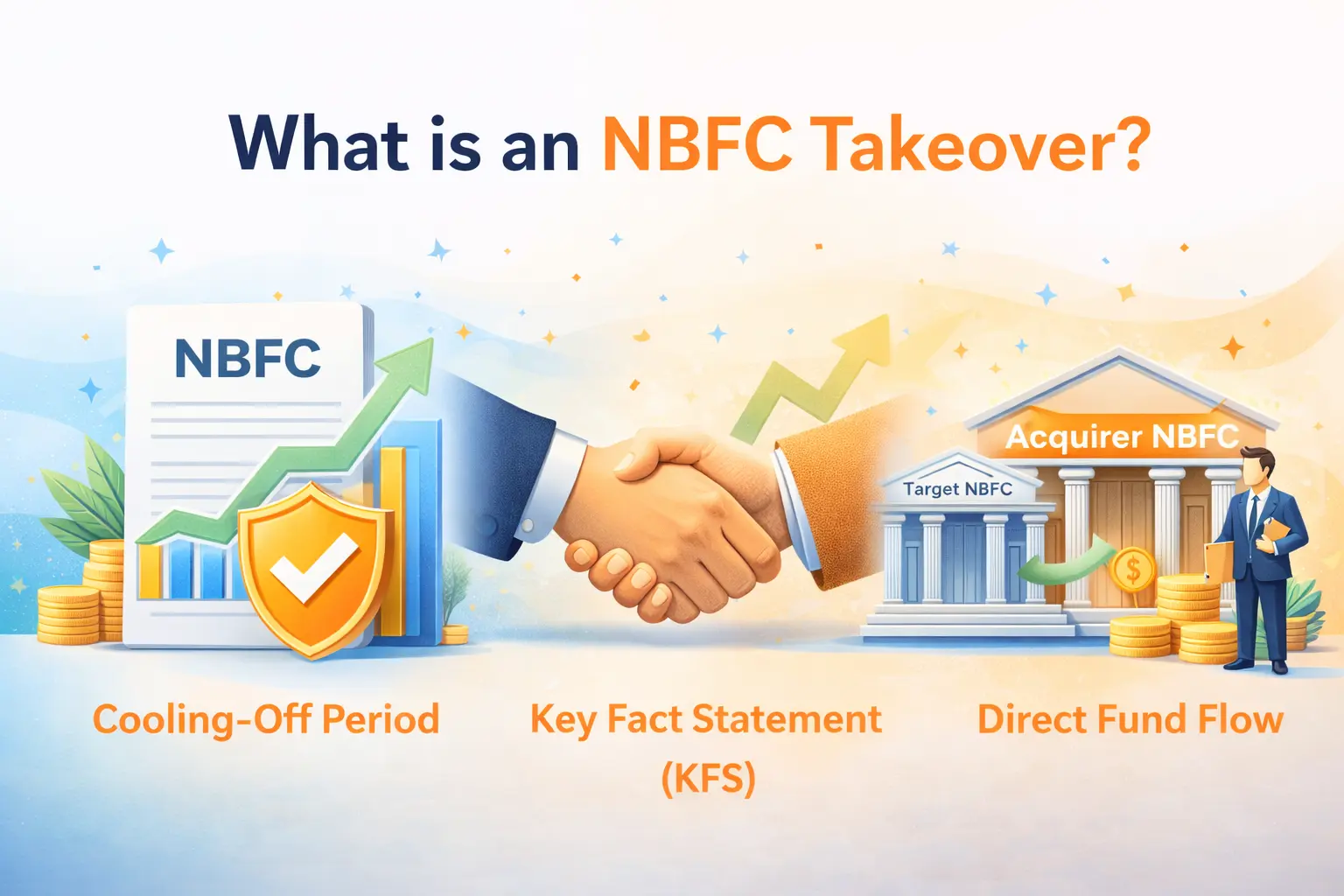
An NBFC takeover refers to the process where an acquiring entity gains control over the management, ownership, or operational assets of an existing, RBI-registered Non-Banking Financial Company (the target). Rather than going through the prolonged process of applying for a fresh NBFC license—which can be time-consuming and capital-intensive—a takeover allows businesses to rapidly enter the financial sector with an already compliant structure, an existing customer base, and operational readiness.
Types of Takeovers
Takeovers in the NBFC sector generally fall into two categories:
- Friendly Takeover: This is a collaborative process where the acquirer and the target company's board of directors mutually agree to the terms of the acquisition. Both parties work together to conduct due diligence, fulfill regulatory requirements, and ensure a smooth transition of management and shares.
- Hostile Takeover: In this scenario, the acquiring entity attempts to take control of the target NBFC without the consent or cooperation of its board. The acquirer may try to purchase a controlling stake directly from shareholders. However, due to the strict RBI regulations surrounding changes in ownership and management, executing a hostile takeover of an NBFC is highly complex and heavily scrutinized by regulators.
The Regulatory Framework Governing NBFC Takeovers
Because NBFCs manage financial assets and operate within the credit system, the Reserve Bank of India (RBI) exercises strict oversight over their ownership. The takeover process is primarily governed by the RBI's Master Directions on Non-Banking Financial Companies (Approval of Acquisition or Transfer of Control) Directions. The regulatory framework ensures that the acquiring entity and its proposed directors meet the RBI’s stringent "fit and proper" criteria.
When is Prior Approval of RBI Mandatory?
Under the RBI Master Directions, an acquirer must obtain prior, written approval from the RBI in the following situations:
- Any takeover or acquisition of control of an NBFC, regardless of whether it results in a change of management.
- Any variation in the shareholding of an NBFC that results in the acquisition or transfer of 26% or more of the paid-up equity capital of the NBFC (including progressive increases over time).
- Any change in the management of the NBFC that results in a change of more than 30% of the directors, excluding Independent Directors.
When is RBI Prior Approval NOT Required?
There are specific, narrow exemptions where the above thresholds are crossed, but prior RBI approval is not mandated (though formal intimation to the RBI is still required):
- When a change in shareholding of 26% or more is strictly due to a share buyback or a reduction in share capital, provided it has the approval of a competent authority (such as the NCLT).
- When a change in the Board of Directors of more than 30% is caused solely by the normal retirement by rotation and subsequent re-election of existing directors.
Step-by-Step Procedure for NBFC Takeover in India
- Memorandum of Understanding (MoU): The process initiates with the acquirer and target company signing an MoU. This agreement outlines the mutual intent to proceed with the takeover. At this stage, a token consideration (advance payment) is usually paid by the acquirer.
- Board Resolutions: Both the acquiring company and the target NBFC must hold board meetings to pass resolutions formally approving the takeover scheme and authorizing representatives to execute filings.
- Comprehensive Due Diligence: The acquirer conducts rigorous financial, legal, and compliance audits of the target NBFC. This step is critical to uncover any hidden liabilities, pending litigations, compliance breaches, or severe Non-Performing Asset (NPA) issues.
- Application to the RBI: A formal application seeking prior approval must be submitted to the RBI. This includes filing the application on the company letterhead to the RBI Regional Office, integrated with submissions through the RBI's PRAVAAH (Platform for Regulatory Application, Validation and AutHorisation) portal. The application must include detailed business plans, KYC documents, and source of funds declarations.
- First Public Notice: After receiving in-principle approval from the RBI, a public notice must be published indicating the intention to transfer ownership or control. This must be published in at least two newspapers: one leading national English daily and one regional language newspaper where the NBFC's registered office is located. The notice must be published at least 30 days before the actual sale of shares or transfer of management.
- Signing the Share Purchase Agreement (SPA): Once the mandatory 30-day public notice period expires without any valid objections from the public or creditors, the parties execute the formal Share Purchase Agreement to legally transfer the shares.
- No Objection Certificate (NOC) from Creditors: The target NBFC must obtain formal NOCs from all existing creditors and debenture holders to ensure they consent to the change in management and ownership.
- Liquidation and Transfer of Assets: If the takeover scheme involves the transfer of assets, a formal entity valuation is conducted by an authorized professional (such as a Chartered Accountant). Assets are then transferred to the acquirer as per the approved terms.
- Final Intimation to RBI and ROC: Upon closing the transaction, the company must update the regulatory bodies. This involves filing the updated director and shareholder structures with the Registrar of Companies (ROC) and submitting a final intimation to the RBI confirming the execution of the takeover.
Document Checklist for RBI Application
When applying for RBI prior approval, the following documents are mandatory for the proposed directors and shareholders:
- Information of Proposed Directors/Shareholders: Complete PAN, DIN, and comprehensive KYC details.
- Financial Proof: Documentary evidence establishing the legitimate source of funds being used for the acquisition.
- Declarations:
- A declaration of non-association with any unincorporated body that accepts public deposits.
- A declaration confirming non-association with any entity whose application for a Certificate of Registration (CoR) has been previously rejected or cancelled by the RBI.
- A non-criminal background declaration, specifically stating no convictions under Section 138 of the Negotiable Instruments Act.
- Reports: A Banker's Report detailing the financial standing of the proposed directors/shareholders, along with their CIBIL/credit reports.
Estimated Timeline for an NBFC Takeover
Because the RBI meticulously vets the background, financial strength, and business intentions of the incoming promoters, the process is extensive. Assuming all documentation is flawless and no major issues are found during due diligence, a complete NBFC takeover—from signing the initial MoU to the final transfer of shares after the 30-day public notice—typically takes between 3 to 6 months.
Conclusion
An NBFC Takeover provides a strategic, accelerated pathway into India's regulated lending sector. However, the regulatory perimeter set by the RBI is exceptionally stringent to safeguard the financial ecosystem. The burden of proof lies heavily on the acquiring entity to demonstrate financial soundness and ethical compliance. Successfully executing a takeover requires meticulous adherence to the RBI's Master Directions, seamless due diligence, and precise coordination through the PRAVAAH portal and public notice requirements.
FAQs
Can the 30-day public notice period be waived if both companies agree to the takeover?
No. The 30-day public notice is a mandatory regulatory requirement under RBI directions. It must be published after receiving RBI's prior approval and at least 30 days before the actual transfer of shares or management, regardless of whether the takeover is friendly.
Does an internal transfer of shares within the same corporate group require RBI approval?
Yes. Even if the transfer is an intra-group transaction, any variation in shareholding that results in the acquisition or transfer of 26% or more of the paid-up equity capital requires prior written approval from the RBI.
What happens if hidden liabilities are discovered after the Share Purchase Agreement is signed?
Once the SPA is executed and the takeover is complete, the acquiring entity assumes all legal and financial responsibilities of the target NBFC. This is why conducting an exhaustive, independent due diligence audit prior to signing the SPA is the most critical protective step for any acquirer.